Industrial MRO · Maintenance · Repair · OperationsSend a requirement · Part number, link, photo or RFQ
Hands-free industrial safety tools

XTendSafe No-Touch Push/Pull Tools

Xtend Your Reach. Xtend Your Safety.

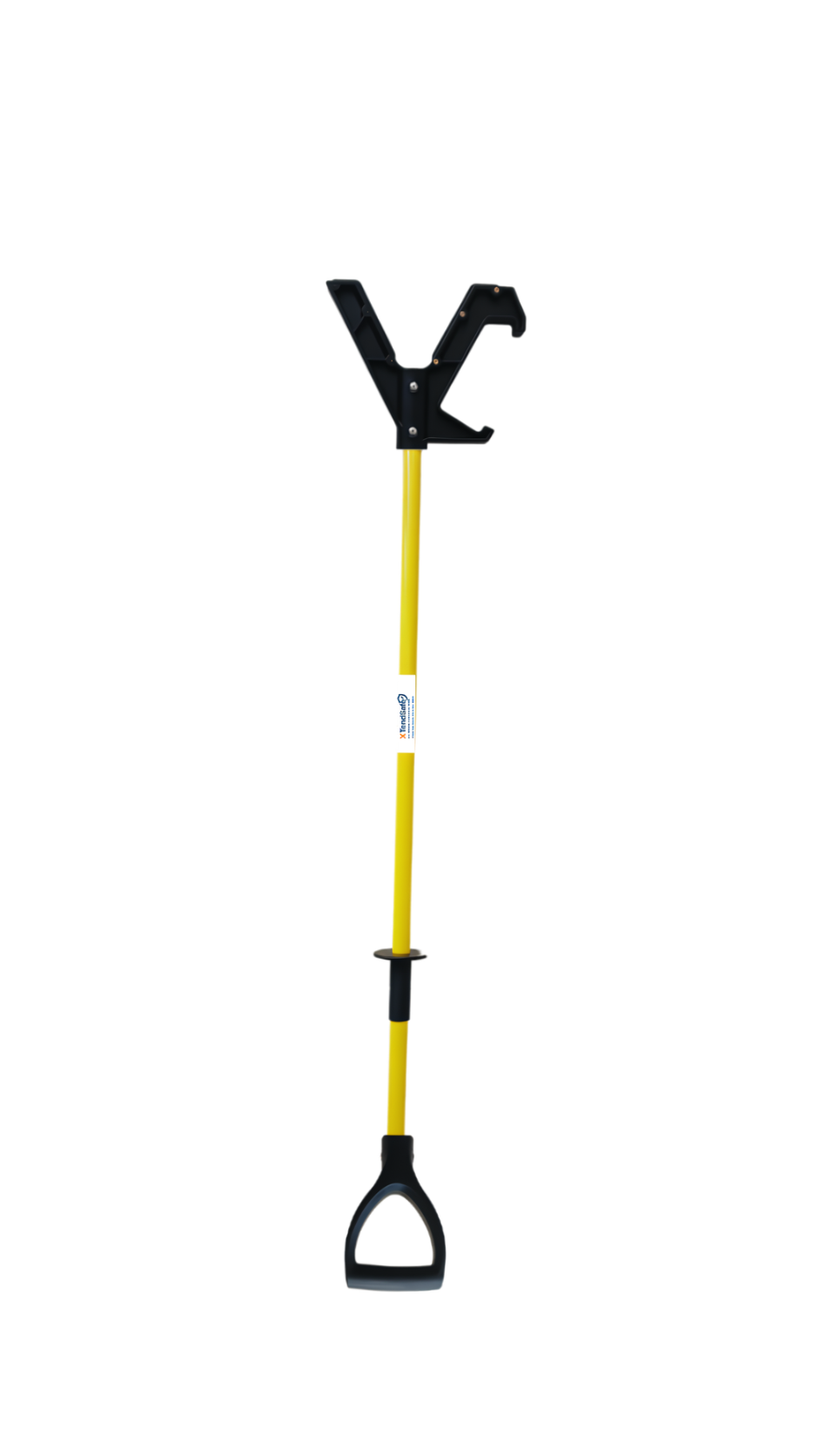
A purpose-built hand-safety and directional-control tool for pushing, pulling, guiding and aligning loads without direct hand contact. Developed for industrial rigging, maintenance, material handling, shutdowns and installation tasks.

Directional control onlyNot for lifting5 available sizes
Original XTendSafe no-touch push/pull tool product photographXTENDSAFE™ / PRODUCT REFERENCE
Push · Pull · Guide · AlignDirectional-control applications
600 mm / 2 ftMinimum hand-to-hazard distance stated in the product literature*
21″ to 96″Five listed size options
01 / Product overview

Keep hands away from the hazard.

XTendSafe No-Touch Push Pull Tools are designed to help avoid direct hand contact when loads or components must be pushed, pulled, guided or aligned. Extending the user's reach helps keep hands outside pinch points, crush zones and line-of-fire areas during final positioning.

Typical work includes rigging, equipment positioning, shutdowns, heavy industrial maintenance and material handling. The tool is described as an engineering-control aid rather than personal protective equipment (PPE).

Key safety principle

If hands are close enough to get hurt, they are too close.

02 / Features & benefits

Designed for control at a safer distance.

01 / NO TOUCH

No-Touch Operation

  • Eliminates direct hand contact with moving or unstable objects during intended use.
  • Keeps hands outside pinch and crush zones.
  • Reduces last-second reaction injury exposure.
02 / REACH

Extended Reach Design

  • Supports a stated 600 mm (2-foot) separation from hazards.*
  • Improves control without stepping closer to a hazard.
  • Allows positioning during final alignment.
03 / MOVEMENT

Controlled Push & Pull

  • Designed for directional control, not lifting.
  • Enables smooth, incremental movement.
  • Helps avoid sudden hand placement during landing.
04 / CONSTRUCTION

Industrial-Grade Construction

  • Developed for refinery, petrochemical and heavy-industry environments.
  • Durable shaft and handle for frequent use.
  • Designed for predictable performance within intended use.
05 / HANDLING

Ergonomic & Field-Ready

  • Intended to reduce wrist strain and over-reaching.
  • Supports balance and body positioning.
  • Purpose-built alternative to improvised pipes or rods.
06 / LIMITS

Not a Lifting Device

XTendSafe is not intended to lift, suspend, support, stop or hold load weight. The load must remain supported by suitable mechanical equipment.

03 / Typical applications

Support the last movement, without reaching in.

The original product page lists the following typical application areas.

Load positioning during rigging
Final alignment of skids, equipment and panels
Guiding loads during landing
Material handling near fixed structures
Maintenance and shutdown work
Work near rollers, conveyors and moving parts
Pipe spool and valve positioning
Offshore and shipyard deck control
04 / Safe-use guidance

Directional control. Never load support.

Universal safe-use rules from the source product page and datasheet. Always follow the site lifting plan and approved procedures.

✓ DO — Mandatory practices

  • Use only for directional control: push, pull, guide and align.
  • Maintain a minimum hand-to-hazard distance of 600 mm (2 ft), as stated in product literature.*
  • Apply smooth, controlled force in line with movement.
  • Ensure 100% of load weight is supported by crane, hoist, rollers or mechanical aids.
  • Maintain line-of-fire awareness and a clear escape path.
  • Inspect shaft, handle and head engagement before use.

✕ DON'T — Critical violations

  • Do not lift, support, stop or hold load weight using the tool.
  • Do not hook it into slings, shackles, chains or rigging gear.
  • Do not side-load, twist or jerk the tool.
  • Do not step into pinch or crush zones for alignment.
  • Do not substitute hands if resistance is felt; stop and reassess.

*The 600 mm figure is stated in the original product literature. Actual working distance and task suitability must be assessed under approved site procedures; a tool length alone does not guarantee safe separation.

05 / Industry-wise usage support

Task guidance across six environments.

Expand each industry to review its typical hazards, recommended practices and restrictions.

01 / Oil & Gas / Petrochemical Plants

Typical hazards

  • Pipe roll-over; sudden centre-of-gravity shift; oily or slippery surfaces; congested pipe racks.

DO

  • Use for pipe spool alignment and valve positioning.
  • Engage the load below its centre of gravity to help prevent roll.
  • Anticipate rotation as slings slacken during landing.
  • Keep feet clear of pipe movement paths.
  • Apply force parallel to the pipe axis for predictable movement.

DON'T

  • Do not stop rolling pipes with hands or feet.
  • Do not reach between pipe and rack for last-inch corrections.
  • Do not push from the high side of an inclined surface.

HSC rule: If hands feel “almost safe,” they are already too close.

02 / Refineries / Shutdown & Turnaround Operations

Typical hazards

  • Time pressure; temporary structures; simultaneous operations (SIMOPS).

DO

  • Use XTendSafe during final positioning, not only during lifting.
  • Maintain extended reach near fixed steel, supports and foundations.
  • Coordinate tool use with lift supervisor and banksman.
  • Use incremental movements during congested alignment.

DON'T

  • Do not rush alignment because of shutdown pressure.
  • Do not place hands inside skid or frame boundaries.
  • Do not apply force with compromised body balance.

Engineering control principle: XTendSafe replaces instinctive hand reach during high-risk moments.

03 / Power Plants (Thermal, Hydro, Nuclear)

Typical hazards

  • Tight tolerances; high-value equipment; fixed foundation pinch points.

DO

  • Use during turbine, pump and motor alignment.
  • Keep the tool face square to the load to prevent sudden slipping.
  • Stop if resistance increases and signal for mechanical adjustment.

DON'T

  • Do not force alignment manually.
  • Do not stand between load and foundation.
  • Do not put hands under base plates or skids.

HSC insight from the source page: hand injuries can arise after the lift, during alignment.

04 / Construction & Precast Yards

Typical hazards

  • Swinging loads; uneven ground; rebar pinch points.

DO

  • Use XTendSafe for approved swing control before landing.
  • Maintain distance while guiding beams, panels or cages.
  • Position the body outside the drop zone.

DON'T

  • Do not catch drifting loads with hands.
  • Do not stand downhill of heavy components.
  • Do not push perpendicular to beam length.

Extend your reach. Extend your safety. Distance is the primary control.

05 / Marine, Shipyards & Offshore

Typical hazards

  • Wind load; vessel motion; wet or slippery decks.

DO

  • Use longer reach where appropriate to manage wind-induced drift.
  • Apply force gradually, accounting for deck movement.
  • Keep the body positioned upwind and out of the line of fire.

DON'T

  • Do not fight wind with body strength.
  • Do not stand between a suspended load and fixed structure.
  • Do not over-correct swing; use small inputs.

Offshore rule: If body weight is needed, the method is unsafe.

06 / Material Handling, Warehouses & Maintenance

Typical hazards

  • Rollers and conveyors; moving parts; fixed structure pinch points.

DO

  • Use XTendSafe to guide loads near rollers or conveyors only when the task is approved.
  • Maintain reach when aligning pallets, crates or equipment.
  • Keep hands out of shear and nip points.

DON'T

  • Do not reach between moving and fixed parts.
  • Do not substitute pipes, rods or scrap material.
  • Do not guide unstable loads without mechanical support.
06 / Available sizes

Choose a suitable reach.

The original product page and datasheet list five sizes. Final selection depends on the task and hazard assessment.

21″Approx. 533 mm
Close-range positioning
42″Approx. 1,067 mm
General maintenance
50″Approx. 1,270 mm
Medium-distance work
72″Approx. 1,829 mm
Rigging and yards
96″Approx. 2,438 mm
Extended reach

Size-specific applications are taken from the datasheet; they are indicative rather than a substitute for task approval.

07 / Frequently asked questions

Common questions, clear answers.

1. What does “Xtend Your Reach. Xtend Your Safety.” mean on site?

It means distance equals protection: hands remain away from pinch and crush points, workers stay out of the line of fire, and the task can be controlled without placing fingers at risk. In rigging and material handling, closer hand placement can increase exposure.

2. What is a no-touch push-pull tool used for?

It increases the distance between hands and hazards, lets workers push, pull, guide or align objects without direct hand contact, and helps avoid finger placement at pinch and crush points. XTendSafe is for extended reach and controlled force, not lifting or load holding.

3. How does a no-touch push-pull tool help prevent hand and finger injuries?

By keeping hands outside the line of fire, supporting the stated minimum separation of 600 mm where appropriate, and allowing controlled movement without touching the load. The source emphasizes final positioning as a frequent high-exposure moment.

4. When should it be used instead of hands?

When hands could enter pinch/crush zones; objects may shift, roll or drop; alignment is needed near fixed structures; or the object is hot, sharp, heavy or unstable. Use only when the equipment and planned method are suitable.

5. Are no-touch push-pull tools load-bearing or lifting devices?

No. XTendSafe does not carry load weight, replace slings, cranes or hoists, or serve as a lifting device. It is for directional control only. Suitable lifting equipment must carry the load weight.

6. What hazards are these tools designed to control?

Source-listed hazards include pinch points, crush zones, line-of-fire exposure, sharp edges, hot surfaces and unexpected load movement. Typical use areas include rigging, maintenance, material handling and shutdown or turnaround work.

7. How far should hands be kept away?

The source recommends at least 600 mm (2 ft) from the hazard and greater separation for heavy, unstable or suspended loads. Final safe distance must be confirmed for the actual operation and site procedure.

8. What surfaces or materials are suitable?

Suitability depends on the tool-head design. The original FAQ says hook/claw versions can suit painted, oily or irregular surfaces, while magnetic versions require suitable clean ferrous surfaces. Select the correct head for the material, surface and movement.

08 / Technical literature

XTendSafe product datasheet

Review technical specifications, size options, applications and mandatory safety rules before use.

Download PDF ↗
09 / Product enquiry

Request XTendSafe product information.

Tell us where and how you plan to use the tool. TechMRO will review the requirement and provide available supply options, product documentation and quotation details.

Email: info@techmroinc.com
Phone: +91 73861 10618

This form sends through a PHP endpoint, not an email application. Configure and test the included handler before publishing.